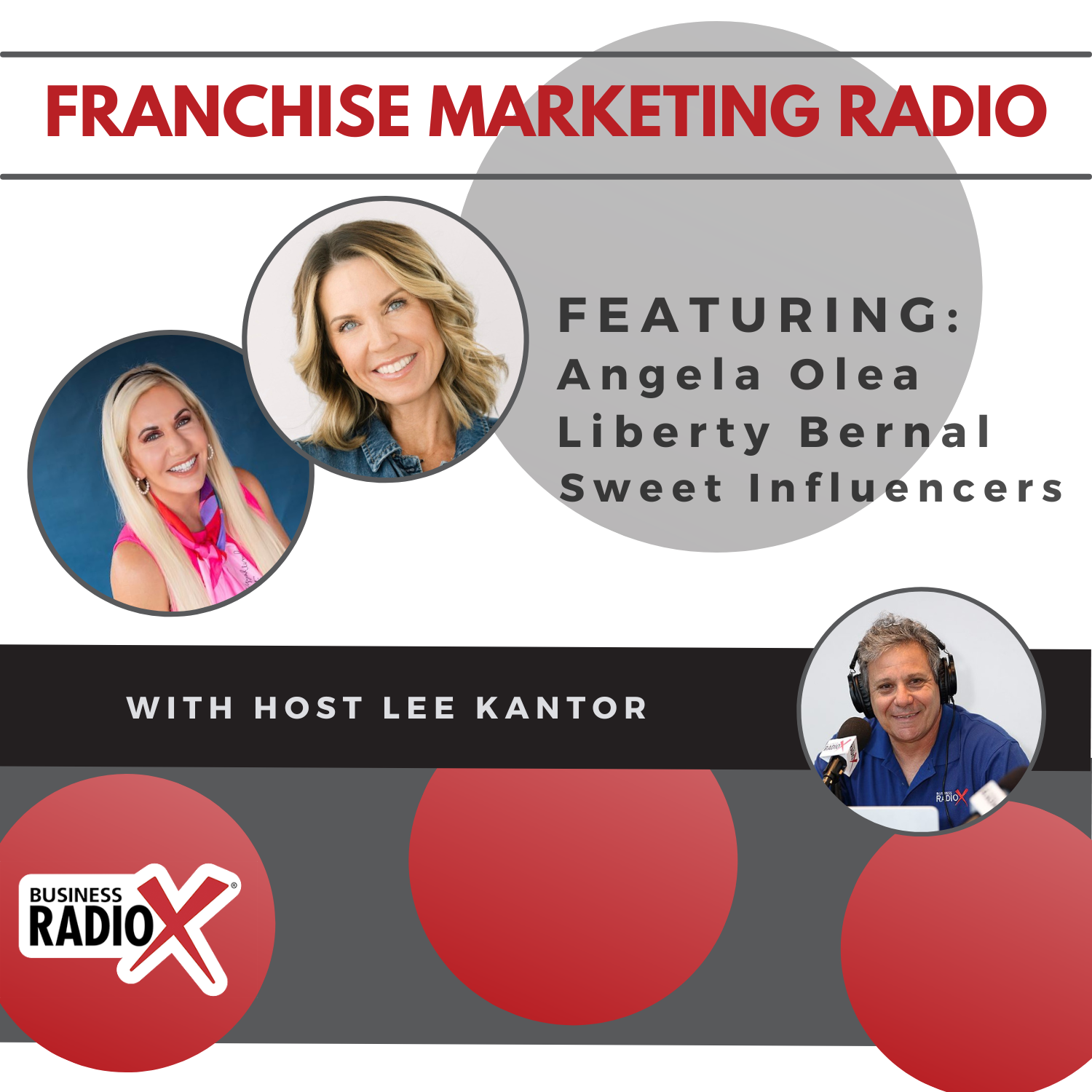

In this episode of Franchise Marketing Radio, Lee Kantor interviews Angela Olea and Liberty Bernal, they are the powerhouse leadership team behind Sweet Influencers, the first AI-powered influencer marketing platform built by franchisors, for franchisors. Angela, a visionary founder in senior care and franchising, previously built Assisted Living Locators into a national brand and continues to be recognized as one of the industry’s most influential leaders. Liberty, a former teen franchisee turned founder, operator, and franchise executive, has spent more than two decades helping brands grow through smart systems, strong marketing, and franchisee-focused strategy. Together, they’re redefining how franchisors scale—using AI, authentic storytelling, and deep franchise expertise to create meaningful, modern growth for brands and the people behind them.

 Angela Olea, CFE, is the Founder and CEO of Sweet Influencers, the first AI-powered influencer marketing platform built by franchisors, for franchisors. A visionary leader in the senior care and franchise industries, Olea has dedicated her career to transforming how businesses grow through trust, technology, and authentic connection.
Before launching Sweet Influencers, Olea founded Assisted Living Locators, the nation’s first senior placement and referral franchise, which she successfully grew into a national brand with hundreds of locations across the U.S. Under her leadership, the company earned recognition as a top senior care franchise and was acquired by Evive Brands, where she continues to serve as a brand ambassador.
A Certified Franchise Executive (CFE) and respected thought leader, Olea has been honored among Franchise Dictionary Magazine’s “50 Women of Wonder” and Franchise Journal’s “Top Influential Women in Franchising.” Through Sweet Influencers, she now empowers franchisors and small business owners to leverage the power of AI and authentic storytelling to scale smarter and engage more meaningfully with their audiences.
 Liberty Bernal is the President and COO of Sweet Influencers, the firstinfluencer marketing platform built by franchisors for franchisors. She hasspent more than two decades shaping the franchise world. Liberty started as an18-year-old franchisee, went on to found and scale Liberty Fitness to 65locations in 18 states, and has since held leadership roles across development,marketing, and franchisee support.
Today she helps brands grow through strategic influencer partnerships, strong systems, and a clear understanding of what franchisees need to succeed. Liberty is known for blending strategy, heart, and execution. She brings a unique mix of high-level franchising experience, creative marketing perspective, and a passion for helping people unlock real opportunities through business ownership.
Alongside her work at Sweet Influencers, Liberty runs a coaching and consulting practice where she supports founders, franchisees, and emerging brands. She is a speaker, writer, and lifelong builder who believes in alignment, energy, and operating with purpose.
Her focus right now is simple. Help franchisors win in an evolving marketplace, support franchisees with tools that really work, and help move the franchise industry forward in a way that feels innovative, grounded, and human.
Follow Sweet Influencers on LinkedIn, Facebook and Twitter.
What You’ll Learn In This Episode
- How AI and human storytelling intersect to transform franchise marketing strategies
- Building trust and consistency across national and local messaging through franchisee advocacy
- Lessons learned from growing a purpose-driven franchise to acquisition and applying those principles to marketing innovation
- Practical ways franchisors can future-proof their marketing while staying authentic and aligned
 This transcript is machine transcribed by Sonix.
TRANSCRIPT
Intro: Coming to you live from the Business RadioX studio. It’s Franchise Marketing Radio.
Lee Kantor: Lee Kantor here. Another episode of Franchise Marketing Radio. And this is going to be a good one. Today on the show we have Angela Olia and Liberty Bernal with sweet influencers. Welcome.
Angela Olea and Liberty Bernal: Thank you.
Lee Kantor: Well, I’m excited to learn what you’re up to. Tell us a little bit about sweet influencers. How are you serving folks?
Angela Olea: Yeah, I’d love to to share about Sweet Influencer. So sweet influencers is what I like to call the creator OS. It is the creator operating system for built by franchisor. Both of us are franchisors, for franchisors, and it blends gen AI human expertise and a scalable growth engine to the franchisor and their franchisees to drive business through authentic influencers to their local business.
Lee Kantor: So what’s the genesis of the idea? How did this come about?
Angela Olea: Well, my history is 20 years of matchmaking, and it was matchmaking. I built a database for matchmaking seniors and senior living providers. And so for 20 years, I had that franchise with 160 franchisees across 32 states. And the tool that I built, it was a great tool, but it still required that human expertise to really deliver to the families that authentic Solutions and I sold to private equity, stayed on for a couple of years and left that business and recognized that this was a huge need. Local franchisees getting them up and getting them successful. And and this is a future. So I am building out a suite influencers to do that matchmaking, matchmaking influencers with the franchisees through the franchisor with authenticity again, that technology mixed with human expertise so pivoted from one to another. But still, you know, doing what I do best, which is matchmaking.
Lee Kantor: And so the client is the franchisor.
Angela Olea: Franchisor and their franchisees.
Lee Kantor: So the so do you target franchisees first or do you target the franchisor first?
Angela Olea: No. Target the franchisees first. And you know, however, if we’ve got franchisees in a system and the franchisor, you know, sometimes it can be a little bit franchise in general, are still pretty much old school and still do traditional marketing. And this is a future. So we know that they’re sometimes proof they need to see proof and and that success. And so, um, if they’re a little bit slow moving to lean into this, sometimes we will work with their, their local franchisee and targeted areas so that they can see proof of concept to, uh, indoctrinate it through the corporate office and go through the system. So, um, you know, we’re we’re going to get there one way or the other, but we prefer to go through the franchisor just because you’ve got mass, we’re able to do it. Um, and in a way that we can, you know, impact more, more franchises more easily.
Lee Kantor: So now when you had the idea in your head, did you think that the franchisor would be more open to trying it? Like did you think it would be kind of once you educate them, then this is kind of a no brainer.
Angela Olea: Yes. Yeah. They just really want to understand what um, Franchisors. They know that their success, their customer is their franchisees. And if their franchisees are happy and successful in making money, it’s going to make them more money and as a result, some more franchises. And so it everybody’s influenced. I mean, we’ve been using technology tools since the Alexa and hopefully mine doesn’t say hello because I said that. But um, leaning into the technology tools, um, it, it is something that they just want to understand how how is influencer marketing, how do we bring this at a local level. And that’s the the hard part is really helping them wrap their minds around how this works and how can they afford it and how can they afford not to?
Lee Kantor: Now, did you have like you had the idea? Did you have somebody beta tested to kind of validate the idea? I mean, franchising is all about validation. So did you have some kind of guinea pig there that you were like, okay, here, this is the concept. Try it out, let me know how it goes.
Angela Olea: We’ve had several guinea pigs through this, and I actually had this idea. I coined the idea in January of 2023. I knew then that I was going to create this. So I’d been baking this for two years before I launched. Um, and through I also go to all of the different, um, franchise development and franchise conferences, um, probably at least 9 to 12 a year. And during that I was able to really do a lot of discovery, find the pain points, who was using it, who was using it successfully, who wasn’t using it, which was 95% of the franchises out there. And so, um, we did develop, um, what our targeted list of Franchisers and their businesses, as well as the industries under those big headings. So we broke it into 14 different headers and then 25 under those and then a couple of those that we just really didn’t feel like they would be good target markets. And um, we started with some really challenging ones, but we’ve been experimenting and piloting and, and really learning with the franchise, um, the franchisors and franchisees as we’ve been doing it. So it’s it’s been amazing. And it really and this is where technology to tools again that human expertise and pivoting just a little bit. You just need to move that needle. If you’ve ever read that 212 um degrees, you know, it’s one little degree of change can really be the difference between, um, a lot of success and a little success, but we’ve nonetheless seen success in in all different aspects that we’ve done. But we’ve got a lot to conquer.
Lee Kantor: Now, can you share maybe a story of of what that success looks like, like what was kind of their challenge, and how were you able to get them to kind of a new level.
Angela Olea: Sure. So I let Liberty take the lead on this one.
Liberty Bernal: Yeah. Um, I would love to. So I would say the biggest challenge overarching in the franchise space when it comes to influencer marketing is a franchisor may not, first of all, completely understand all that working with an influencer entails. But second of all, if they know what’s important, um, you know, in some way to do at a local level, they may just suggest to their franchisee, hey, find a local influencer and have them talk about the business. Right. And how sort of cringey is that? Because the first role of the franchisor, as we know, is to protect the brand. And so even guiding a franchisee to attempt to protect a brand with an influencer is quite challenging. Um, so with our first pilots, what we’ve done has been able to take an influencer marketing campaign from a all the way to Z. For them, that’s really the service that we offer with sweet influencers. So, um, in the Phoenix market, for example, there was a dog grooming franchisee and mobile dog grooming, and he really wanted to attract more clients to have their dogs groomed. So really it was identifying in our role. And our team finds really strong influencers in the local level.
Liberty Bernal: And these aren’t huge influencers. Lee, who might charge $50,000 per post, these are micro influencers who might charge a few hundred dollars per post, or perhaps a trade. So it’s very manageable for a franchisees marketing budget. And then the entire process is managed again through our team, through a combination of AI and real humans. So we will identify the influencers in the local level with our AI tools. Well, you know, hold the hand of the franchisee who may not understand what to do or what questions to ask. Identify the influencers, approve them, you know, sign the contract with them. Get the campaign going. You provide the influencers with the information they need to generate that great content, connect the dots, follow through to the end, and then track and measure on those important KPIs. So I would say, you know, in a very quick sense, that’s what it looks like from start to finish. And the big problem that we’re solving is the big I don’t know, you know, a lot of both franchisors and franchisees say we know influencer marketing is important. And we see marketing’s gone in that direction, but we don’t know where to start. And we come in and solve that problem 100%.
Lee Kantor: Now, it sounds like you’re running kind of a two sided marketplace where you have to have access to influencers and you have to have access to the brands. Or is the you don’t access the influencers until you need them. Is that how it kind of works?
Liberty Bernal: It’s really twofold. We have a database of influencers that we’ve already vetted and that continues to grow. So on our team we have people actually are scouring the social channels again using AI, but using their eyes and their ears and their senses to make sure that they are great influencers who don’t have any weird skeletons in their closet, for example. Um, so we have them vetted and ready to go so they’re easier for us to work with. But also if we do partner up with a brand and they have a unique selling proposition that we might not immediately have the perfect influencer for, that’s when our team, I call it influencer hunting. But we do send them, you know, again online, identifying the perfect influencer that fits the brand. Um, so that’s you’re you’re correct. We have existing and sometimes we have to find new.
Lee Kantor: And for the influence out there that might be listening, what can they be doing to attract a firm like yours or any type of firm that maybe is scouting influencers like you mentioned? Micro-influencers? Influencers. What is the like? How are you defining Micro-influencer is that you know, ten followers or is it a, you know, 10,000? Like is there a minimum like how do you define a micro-influencer?
Liberty Bernal: Well, that’s a great question. And Angela, if you have it memorized, I may call on you, but essentially my quick reference is a Micro-influencer is about 10,000, maybe 20,000 followers. Um, so there are there’s actually one even smaller lease. It’s called nano, and they might be 2000 to 10,000, and we go all the way up to what we call macro, which could be millions, right? Like the macro influencer who has 4 million TikTok followers and thousands and thousands of likes per post. So when we’re identifying the nano and the micro or we’re we’re guiding them because we do have a process, we actually we have paid media out there from our company looking for these great micro influencers, and they can sign up with us. There’s no charge, but they enter our database. We we make sure that they’re the right fit for us in general. Again, lacking skeletons in the closet kind of thing. Um, but I would suggest to any, you know, macro micro who might feel flustered, especially like, where do I begin? Or how do I grow? Um, you know, agencies are looking and certainly sweet influencers are looking to fill the database and get them, you know, essentially work. It’s what they’re doing for a living. Or maybe it’s a, you know, kind of side hustle that can grow into much more.
Lee Kantor: Now, how do you kind of determine if that influencer is who they say they are? Like in today’s world, everybody knows it’s so easy to game the system to overnight, you know, have millions of followers or at least thousands or hundreds of thousands. That’s not that expensive to get that number. How do you kind of, you know, there’s an old, uh, New Yorker cartoon says that nobody on the internet knows you’re a dog. Like, you know, how do you kind of determine they are who they are pretending to be, or at least seeming to be.
Angela Olea: That we have tools that help identify what percentage of fake followers that they have. So we’ve got every day I can look up different influencers. I can see, uh, what their engagement’s been. It looks at how many posts that they’ve done. How what are the comments? There’s a there’s a percentage, an algorithm that the AI has been trained to, um, to identify. And it looks at a multitude of their posts. You know, if they go if suddenly something goes viral, you know, how what was their history of, of engagement. So it, it has the tool baked in. Um, because that is we want to make sure that what we’re seeing, um, is authentic. And there again, that’s where we also look for the, um, the hybrid where it will identify different influencers based on the criteria that we get it, but then we want to have the the human touch as well. What is the sentiment of that person? Does it match. And then we’re we’re measuring we’re doing a B testing when we do, um, utilize to identify what is working better because the tools have it. But as we work with a brand and we continue to work with the brand, um, using the AI, it will continue to, um, get better and better at recognizing. And that’s why franchise systems, that’s why it’s so appealing working with a franchisor and their franchisees because of that recurrent learning, um, that it can do with slight adjustments based on geography, etc.. Um, and we can get better and better at what, um, what identifying what influencers really help bring them their targeted audience for that franchisee and that local market.
Lee Kantor: And then when you’re drilling down to the KPI for the franchisee, is it like awareness? Is it just brand awareness or is it I got somebody bought a cookie today you know.
Angela Olea: Great question. So there’s going to be different reasons from if somebody is having you know, what are they trying to do. Is this a grand opening that’s going to be a different type of campaign than maybe it’s a mother’s day special? Um, you know, or Black Friday, you know, something like that. If you’re a massage place and you’ve got specials that you’re running or if it’s, you know, for the dog washing, I mean, their KPI is their number one KPI is setting initial appointments on the phone. You know, that’s their number one driver of business. So what what is going to cause, um, you know, what is going to have the biggest splash, biggest impact. And that would be for that particular brand. That’s what we’re trying to accomplish. And so it’s utilizing different tools and technology to track the success of it. And you know, it’s sometimes it can be overnight success. But again, sometimes it does need a little bit of adjustment. And um, oftentimes and what I love about this, one of our, our, uh, one of our early clients, um, we were able to bring a whole new market to them. It was an estate sale company, and we were able to bring, um, their typical client was 35 and older, female. That was their, uh, estate sale hunter. And we brought in a different market that was a 20 something thrifter and whole new generation of, of, um, estate sale followers. And so that was something they didn’t see in their initial um identifier, and that wasn’t even what was in their FTD of their, their typical client.
Lee Kantor: Now, when you I mean, you talk a lot about utilizing AI. Are you utilizing it um, for kind of data and analysis. Are you using it for messaging? Like, are you saying, hey, influencer, say this.
Liberty Bernal: Actually, the main use of our AI is in searching for the right influencers. So we actually have a proprietary platform that we’ve built to do that and do it really well. Um, so the messaging, I mean, we have a team that develops the campaigns. So, you know, is AI used to double and triple check? It’s the best, of course, but our main use of AI is that, um, partnership of using the tool, the AI tool to find the influencer. And then again, our humans on our team to make sure that those influencers really are the right fit, because we’re often going into the history of the influencers to make sure that even a year or two ago or even longer, they didn’t talk about something that could potentially damage the brand that we’re having them represent now.
Lee Kantor: But the human storytelling component of it is the influencer. Being the influencer, are you kind of scripting what they do and say.
Liberty Bernal: You know, we guide them. So it’s typical in any kind of influencer marketing or, you know, UGC that user generated content, if someone is hired by a brand, they are often given brand guidelines. So that’s really important for what we do. Um, you know, to protect the brand. Certainly number one aspect of the franchise marketing is to do that. Um, so we give them guidelines. But remember that part of influencer marketing is an authentic voice. So we’re really careful to not word for word script for the influencers. We do want them to experience the product or service and talk about it in their voice. And, you know, given they have a following because of their voice. So you don’t want to take away from that. But we do give them guidelines and their campaign briefs, um, about the brand so they know what points are most important to touch on. An example would be organic, the dog washing. You know, one of the things that was really important to them was the organic washing that they do that that the chemicals that it’s chemical free, that it’s uh, the, the styling tools, etc.. And so we will put keywords in there for them to make sure that they include it maybe in their video that they’re showcasing it. It could be zooming in the picture, they could mention it. But like Liberty said, that authenticity and that fun, um, that funniness that they bring or whatever their personality that they’re bringing, that’s why we’re we’re engaging with them because we want it. It’s going to hit different people and attract different people differently. They’re going to hear it, see it, feel it differently. And by using different influencers, we’re really able to capture those different sentiments and see what what moves that needle the the furthest.
Lee Kantor: And that’s I would imagine, one of the challenges when you’re dealing with kind of corporates in charge of a brand to trust individual, authentic humans to protect the brand.
Liberty Bernal: I think that is probably the challenge for your typical CMO or director of marketing. Yes. But again, it’s um, it’s so much where marketing has gone, especially digital marketing. We do see the comfort level changing with every conversation, but it can be it can be hard.
Lee Kantor: Well, I mean, these are people that like control or at least the perception of control. And then now you’re saying, trust me on this, I’m going to we’re going to put your brand in the hands of hundreds of individuals out there, and they’re going to be great, you know.
Angela Olea: Cruise before it goes live. So it’s it’s not it, it is even though it may seem like a wild, wild west. We get to see it before it goes live because they may have missed something in there or misspelled something. It’s got to have a hashtag that that indicates this is sponsored. Um, so there there are definitely things that need to be blessed before it goes live on a post. But, um, once it goes live there, that’s when we’re able to really maximize that. It’s not just a post. It could be that we’re advertising using their, um, their site to boost it. We could have the rights to that and it could go on. The franchisee could potentially use that in their marketing and build their assets for continued ongoing. So it’s it can get a lot of mileage for, um, a small investment.
Lee Kantor: So everything has to be approved. That’s pretty that seems like logistically challenging.
Angela Olea: No, no, it’s it’s easy. Um, because there’s not a lot these are short. These are. It’s not an hour clip. These are usually, you know, no more than three minutes, sometimes a minute. Uh, they’re very short clips to, to look at and to approve.
Lee Kantor: So they’re not doing any live streaming obviously.
Angela Olea and Liberty Bernal: No.
Lee Kantor: And that’s by design. So you can can control that.
Angela Olea: Yep. And we’re using primarily right now it’s Instagram, TikTok. Um, we can use YouTube Facebook. Those are primarily the ones that that are for the audiences that we have. Those are probably the biggest social media, um, sites that for the market that we’re looking for.
Lee Kantor: Now, are your targets primarily B2C franchises or B2B or mixture?
Angela Olea: O uh, Liberty. Do you want to primarily, I think there’s there’s a mix in there. There really is a mix going on. So it doesn’t really have to be one or the other. She can imagine, you know, I guess be to see, it might initially sound like, oh, probably that focus. But we certainly see it all. And, you know, most people are on social media, right? They’re looking and they have a need. So really who we match influencers with is an audience need. So it might not initially make sense. Um, let’s say there’s a nutrition focused franchise. We don’t find nutritionists in the local area. We might just find out first, what are the demographics of the audience that makes the most purchases for this brand? We’re going to target those influencers with the right fit demographically, and that can work B2C or B2B. And this could be everything from a brand that, um, I mentioned earlier. It could be a roofing company, it could be a landscaping company, it could be, uh, as Liberty mentioned, a fitness there. There are literally everybody has an audience and something that’s going to appeal to them. Um, and where where do you intersect with that audience and what triggers that? Um, I know certainly I’m, I’m influenced. I’ve bought all kinds of gadgetry. I buy it all the time. I see something on, on line and and you know, it. It works. Influencer marketing works. So we’re tapping into that, building a moat around it, um, so that we can move as quickly and as authentically. There’s a lot of, uh, AI slash influencer marketing companies out there. They do not understand franchising at all. They don’t understand the intricacies like Liberty and I do, and our team does, and how it needs protecting and why you need what you need. And as I mentioned, even the hashtag sponsored making a mistake like that can really bring, um, penalties and get you banned. So Sell. It is something that we know to look out for and watch out for.
Lee Kantor: So how do you kind of recommend a franchisor to kick the tires on this? Is there a way to ease into this, or do they have to kind of bite off the whole thing and go all in?
Angela Olea: No, we can work with a couple of there, there. Um, we want to work with their stores. It could be a company store. We want to work with franchisees that are already that. They know how to handle a lead, that they’re a franchise system that is really tracking their KPIs. They already know their numbers so that we can truly work with them as a partner to ensure that they’re going to be nimble in how they’re adjusting and adapting to these types of leads, and that we’re measuring appropriately. And if we need to modify it, that we can be quick in how we adapt it. Um, and again, it’s we don’t want to work with brand new. Not not in the test mode. So if they want to have a couple of different markets that we’re testing it to get that proof of concept, then roll it out. We are 100% confident and comfortable with our model to do that.
Lee Kantor: So they can test it in a couple. You can pilot it in a couple markets just to see if it’s going to deliver what you promise it.
Angela Olea: Absolutely. You said that very well. I’m a wordsmith. Whatever. Whatever language I was speaking. You translated that beautifully. Thank you.
Lee Kantor: Now, when a company says, okay, I’m in, I’m going to do this. Is this something that they can tell it’s working pretty quickly, or is this something that has to build over time?
Angela Olea: They can tell. They can tell it’s working. I mean, the most basic way you can tell it’s working is engagement. So the lovely thing about our social media channels is you can see views, you can see likes, you can see engagements, DMs, and oftentimes if there’s any product or service, we can assign an influencer a promo code. And with that promo code, whomever the viewer may be who wants to try out the service, they can use the promo code and it’s very easily trackable. We do have other methods of trackability, but it’s it’s marketing at its finest in that sense, because it is so darn trackable and even the ability to see views alone. Instead of sending a mailer and you wonder who opens it, right? We literally can see who opens it, so to speak.
Angela Olea: Lee, one of the things that some may have a bigger sales cycle. So in one instance it could be very, very fast. Say we had a promo code for pizza and we’re running, you know, or the estate sale. I mentioned the estate sale. They have a three day run at a site. And that sale as soon as they post at 7 a.m. when that sale goes live, um, at 7 a.m. on a Friday. And we can see that that run for that weekend. But then there’s a long term value. As I mentioned, they’ve got now repeatable customers. They’ve got people that are following them and joining. But if we have, say, a cabinet company that their average ticket price might be 25 to 35,000 and this might be a kitchen remodel, um, cabinetry that’s going to be a little bit longer of a sales cycle where they’ve got to set the appointment. They’ve got to. But did we get their phone to ring? Are they getting the appointments? Um, and so that sales cycle is going to be a little bit longer just because of the price tag. But they’re also going to see that, you know, return on their investment. Um, you know, obviously if your average ticket price is I’m just going to say $30,000, you know, that’s going to be huge versus a pizza, which it might be, you know, $18. So you’re going to do volume with one faster. One’s going to be a little bit longer longer term because you’ve got that appointment cycle quote, etc..
Lee Kantor: Now what’s kind of the challenge that your franchisors having right now where you’re you’re the answer for them? Are they just being frustrated or they feel like they’re missing out on leveraging influencers and AI and storytelling the way that you’re doing it? Like, what’s kind of the pain they’re having right before they hire you?
Angela Olea: Yeah, they’ve got off brand messaging, so if they’ve tried it, they’re going to see that. They’re guessing at, you know, what is the messaging. They’ve got one off campaigns. Um, they’re going to see that that creators are ghosting them, that it’s a it’s a volume. It’s, you know, we call it the suite elite. Our, our influencers that we’ve vetted, contracted, etc.. Um, and then also are they’re, they’re not really untrackable on their results. They’re not tracking them. They don’t have the tools like we do where we can see live what the engagement rates, the comments that that it all of that happens, um, you know, real time that we’re able to see it and share that reporting with the Franchisers.
Lee Kantor: So if somebody wants to learn more, have a more substantive conversation with you or somebody on the team, what is the website? What’s the best way to connect?
Angela Olea: Yeah, it’s sweet influencers. My sweet influencers, plural dot AI. And uh, yeah, we can set up a call and tell them how, uh, learn more about them, create a brief and, you know, share with them what we think. Um, and, and what’s a next step for rolling it out?
Lee Kantor: Well, Angela and Liberty, thank you so much for sharing your story today. You’re doing such important work, and we appreciate you.
Angela Olea: Thank you for having us.
Lee Kantor: All right. This is Lee Kantor. We’ll see you all next time on Franchise Marketing Radio.














